

Department guide · Stunts
Designing the action, rehearsing it until it is safe, then performing it.
The stunt department plans and performs any action that carries a risk of injury, under a stunt coordinator.

Career ladder · 5 grades
Probationary member to Full member
Stunt work under a BSR-registered coordinator only.

Learning path · free · 19 films
Stunts, SFX and armoury: awareness for everyone on set
Awareness only, never how-to. How UK sets plan action and effects safely, who's in charge (stunt coordinator, SFX supervisor, armourer, medic), the British Stunt Register, and what you do as a bystander. Checked 11 November 2026.
Watch: Stunts

Watch
What Was Happening 100 Years Ago? | 1926 on Film
California - Stunt Gone Wrong (0:00 - 00:21) (Film ID 658.20) Peking - Men at Work (00:21 - 00:41) (Film ID 888.06) Italy - Public Fountains Run with Wine (00:41 -…
British Pathé · original on YouTube
Career ladder
From first job to head of department
Entry needs qualifications across set sporting disciplines and a minimum age of 18. Grades as the BSR published them in 2019; check the register for current rules.
British Stunt Register grades
-
Entry grade
Probationary member
Stunt work under a BSR-registered coordinator only.Watch and read
-
Step 2 Stunt performer Stunt work, still under a coordinator.
-
Step 3 Senior stunt performer Can risk-assess and work without a coordinator on some jobs.
-
Step 4 Key stunt performer Assisting an experienced coordinator on bigger action.
-
 Top of the ladder
Full memberAlso: stunt coordinator
Can conceive, coordinate and supervise action as stunt coordinator.Watch and read
Grade by grade: what you need before moving up
| Grade | What you do | Before moving up |
|---|---|---|
| Probationary member | Stunt work under a BSR-registered coordinator only. | Required time and experience as a probationary. |
| Stunt performer | Stunt work, still under a coordinator. | More credits and experience. |
| Senior stunt performer | Can risk-assess and work without a coordinator on some jobs. | Experience leading your own stunts. |
| Key stunt performer | Assisting an experienced coordinator on bigger action. | Running action alongside a coordinator. |
| Full memberAlso: stunt coordinator | Can conceive, coordinate and supervise action as stunt coordinator. | The coordinator's role on productions. |
British Stunt Register · Every department's ladder: Careers A–Z · Getting work · Working freelance
Learn it, step by step
4 paths- Health and safety · New to setStunts, SFX and armoury: awareness for everyone on set19 lessons · about 4.5 hours · freeStart path
- Health and safety · New to setYour first day on set19 lessons · about 3 hours · freeStart path
 Learning path · step-up → proStep up: your first time as HoD or supervisor18 lessons · about 6 hours · freeStart path
 Production · New to set to working crewProducing and development10 lessons · about 7 hours · freeStart path
Safety first
The coordinator's plan and staying out of the action
Stunts are planned, rehearsed and run by the stunt coordinator with registered performers. Nobody else attempts, changes or improvises a stunt. Everyone else learns where to stand and when to stay still.
Watch first
Module 1 of Stunts, SFX and armoury: awareness for everyone on set. Mark them done there to track your progress.
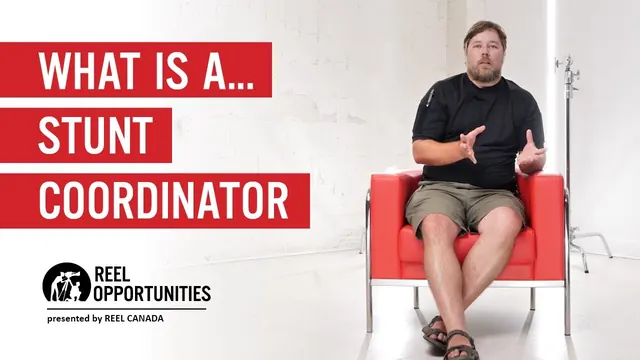
- 1:52What is a... Stunt Coordinator? | Careers in FilmReel Opportunities · 1:52
 23:49Stunt Coordinators: What Do They Do? An Interview with America YoungCineD · 23:49
- 17:44Introduction to Health and Safety in Film and TelevisionXpoNorth Digital · 17:44
The hazards
6What hurts people in this department on UK sets, and what keeps them safe.
- Only registered performersOn UK productions, stunts are done by performers on the British Stunt Register under a registered coordinator. Actors only do what the coordinator has planned and rehearsed with them.
- The plan and the rehearsalEvery stunt has a plan, a risk assessment and a rehearsal. Nothing changes after rehearsal without the coordinator agreeing it and the unit being re-briefed.
- Where you standThe briefing tells you where to stand. Stay there. Moving to get a better look is how crew end up in the path of a vehicle, fall or fight.
- VehiclesStunt driving happens on controlled roads or sites, with marshals. Crew stay behind barriers or where the coordinator puts them.
- Height, water and fightsFalls, water work and fights each have specialists and kit that are not to be touched or moved. Pads, rigs and wires are set by the stunt team only.
- Medical coverA medic is on set for stunt days. Know where they are. If someone is hurt, the coordinator and medic go in first.
Who is responsible
- The stunt coordinator plans and runs every stunt, and has final say on its safety.
- Registered stunt performers do the stunts.
- The 1st AD briefs, rehearses and calls them.
- The unit medic is on set for stunt work.
As a trainee, never
- Never attempt, demonstrate or 'try out' a stunt or a fall.
- Never move pads, rigs, wires or markers set by the stunt team.
- Never cross or stand in the action area until the coordinator gives the all-clear.
Anyone can say stop. If something feels wrong, say so to your head of department or the 1st AD.
Where this comes from
- The British Stunt RegisterThe register of qualified stunt performers and coordinators used on UK productions.
- HSE: theatre, film and TVThe Health and Safety Executive's guidance for screen and stage.
- HSE: managing risks and risk assessmentThe employer's duty to assess risk (Management of Health and Safety at Work Regulations 1999).
- HSE: first aid at workWhat first aid cover an employer must provide.
- Mark Milsome FoundationSafety training and support for crew and new entrants.
Checked 13 November 2026. This is awareness, not a safety qualification: follow your production's risk assessment and your head of department.
Stunts, in detail
What it does on a UK unit
Anything that could injure someone goes to the stunt coordinator: falls, fights, fire, vehicle hits, high work, water, horses, anything beyond acting. The coordinator designs the action with the director, plans it with the 1st AD and other departments, casts and rehearses the performers, and supervises on the day.
Stunt performers double actors, play their own roles in action, and do the stunts. Big shows have a stunt team in prep for weeks, with rehearsal space, riggers and fight choreographers.
Registration and competence
- The law asks for competence. The HSE says producers must make sure only people with the necessary competence, knowledge, experience and training take part in a stunt, and that stunts are normally performed by a stunt performer competent for that stunt (HSE ETIS17, 2017).
- The register is how the industry shows competence. From 1973 the UK stunt register was overseen by industry committees, including the Joint Industry Stunt Committee (JISC). It was known as the Equity register or the JISC register, and its grading scheme was the Joint Industry Grading Scheme (JIGS). It was disbanded in 2017. HSE's 2017 guidance still points to JIGS, so read it with that in mind.
- Since November 2017, the British Stunt Register (BSR) has been the UK's peer-reviewed register of stunt performers and coordinators. It is a members' association with an office at Pinewood Studios. No law requires membership, but it is the main way UK productions check a stunt professional's grade.
Check the British Stunt Register directly for current entry rules and grades. They have been revised since 2017.
Who it works with
- Director and 1st AD: what the action is, and how and when it is shot safely.
- SFX: fire, explosions, rigs and vehicle effects.
- Costume and hair and make-up: doubles' costumes, padding, wigs and matching.
- Camera and grip: camera positions, crash boxes and cars.
- Unit medic and safety adviser: medical cover and risk assessment.
Kit and vocabulary
| Term | What it means |
|---|---|
| Double | A stunt performer standing in for an actor in action |
| Fall | A planned fall, from a stumble to a high fall onto an airbag |
| Ratchet | A rig that pulls a performer suddenly, for a hit or a blast |
| Descender | A controlled-speed wire device for falls |
| Crash mat / airbag | Landing protection for falls |
| Fight choreography | The designed, rehearsed sequence of a fight |
| Stunt rigger | Specialist who rigs wires, harnesses and descenders |
How to get in
There is no quick route. The BSR asks for high-level, independently verified achievement in several sporting disciplines across set categories, including a martial art, plus acting experience and a minimum age of 18. Training usually takes years. Read the BSR's current requirements before you spend money on courses.
Pay
There is no Bectu stunt card. Stunt performers and coordinators are represented by Equity, which negotiates with producers.
Where Futures in Film helps
We don't train stunt performers. These pages are a start:
- Your first day on set: how the floor works and how a safety briefing reaches you.
- Routes in: other routes into the industry.
- Representation and rates: unions, guilds and rate cards.
Who to know: Stunts
 BFC Skills and Social Responsibility Directory Searchable directory of UK organisations running screen training, skills and inclusion schemes.
 ScreenSkills job profiles Profiles of hundreds of screen jobs: what each role does and how to get in.
 ScreenSkills Select ScreenSkills' endorsement of university and college courses that are relevant to industry.
 6ft From the Spotlight Wellbeing and welfare support for UK productions and crew.
 BEAU (Broadcasting, Entertainment and Arts Unions) Brings together Bectu, Equity, the Musicians' Union and the Writers' Guild; formerly FEU and FEU Training.
 Bectu branches Bectu's craft and regional branches (camera, grips, costume and wardrobe, hair and make-up, art department and more) represent each grade.
 British Stunt Register Professional stunt organisation for the UK; shows how stunt performers qualify and are graded.
Other departments
17 departments Camera, 1187 films
 Lighting, 252 films
 Grip, 147 films
 Sound, 214 films
 Virtual production New, 118 films
 AI tools New, 83 films
 Art department, 149 films
 Costume, 94 films
 Hair and make-up, 54 films
 Assistant directors, 54 films
 Production, 654 films
 Locations, 84 films
 Script supervision, 108 films
 Editorial and post, 469 films
 VFX, 218 films
 SFX, 20 films
 Health and safety, 73 films
Last reviewed 9 November 2026