

Working in the industry · Working freelance
Get booked, get paid, stay on the right side of HMRC.
Most crew work job to job. Here's the paperwork nobody explains: tax status, invoices, insurance and contracts, with free templates and a day-rate calculator.
Watch first
8Short official explainers from HMRC, ScreenSkills, BAFTA and the Film and TV Charity. They play here.
 2:33My first Self Assessment tax returnHMRC · 2:33
 2:11What self-employed expenses can I include in my tax return?HMRC · 2:11
 10:04How to be a successful freelancer in film and TV, with Sara PuttBAFTA Guru · 10:04
 3:25How do I sign up for Making Tax Digital for Income Tax?HMRC · 3:25
 2:33Financial support and guidanceThe Film and TV Charity · 2:33
 2:13Mental health supportThe Film and TV Charity · 2:13
 4:24Job sharing as a freelancer in televisionShare My Telly Job · 4:24
 2:27Freelance Toolkit: managing your financesScreenSkills · 2:27
Free templates
Edit them in Word, Excel, Google Docs or Numbers. No sign-up. Each file carries its version and the date we checked it.
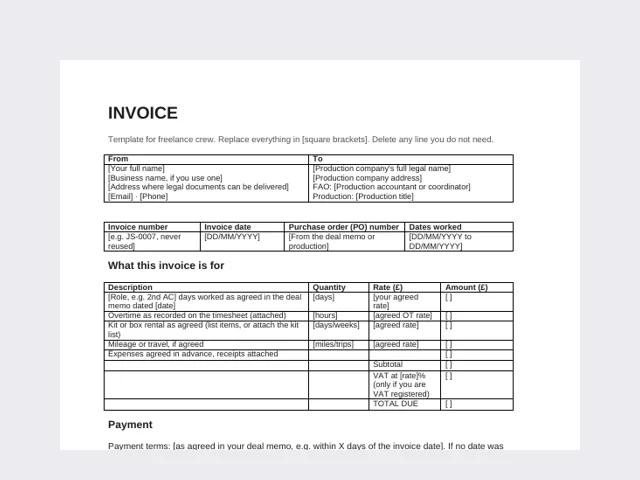 Word · DOCXInvoice templateEvery field GOV.UK says an invoice must carry, laid out the way production accounts expect.Download Invoice template (Word · DOCX)
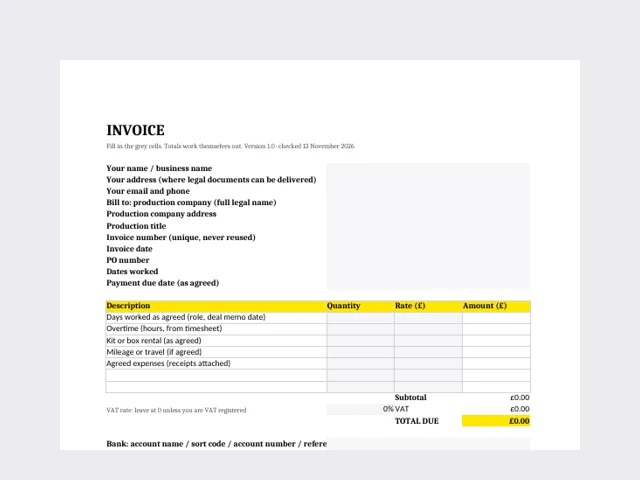 Excel · XLSXInvoice that adds itself upType days, overtime and kit; the totals and VAT line work themselves out.Download Invoice that adds itself up (Excel · XLSX)
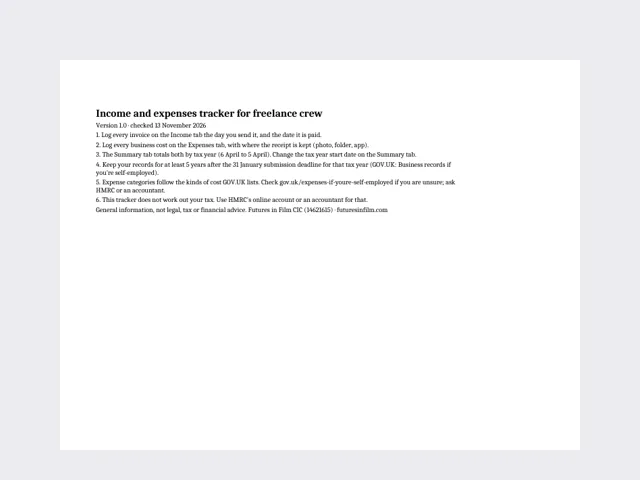 Excel · XLSXIncome and expenses trackerLog invoices and costs, see who's late paying, and total the tax year.Download Income and expenses tracker (Excel · XLSX)
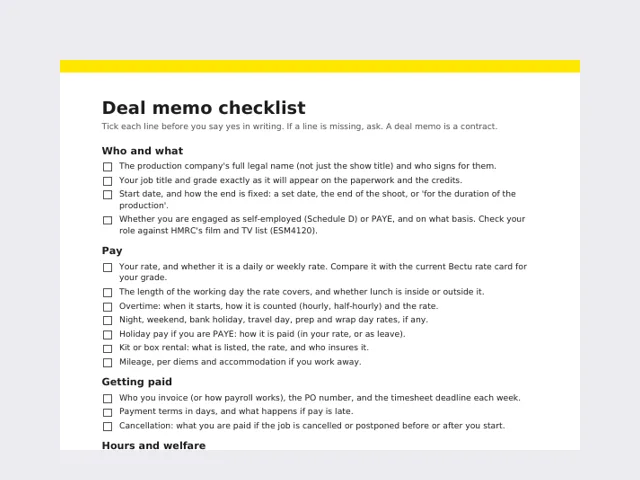 PDF · 1 pageDeal memo checklistTwenty-two things to check before you say yes in writing.Download Deal memo checklist (PDF · 1 page)
Status
Employed or self-employed? It depends on the job, not on you.
The production decides your status for each job. HMRC keeps a list of behind-camera roles it normally treats as self-employed, rewritten on 7 October 2026.
Self-employed (Schedule D)
You invoice, and pay your own tax
You're paid gross. You send invoices, register for Self Assessment, and pay Income Tax and Class 4 National Insurance yourself. No holiday pay or workplace pension from the production.
Employed for tax (PAYE)
Payroll takes tax off first
You fill in a start form and fill in timesheets. Payroll deducts tax and National Insurance, and you're due holiday pay. You may be enrolled in a workplace pension.
How the list works
On the list, and passes test A or test B
Test A is particular to each role: bringing your own substantial kit at your own risk, working mostly away from the production's premises, or having other clients at the same time.
Test B: you're booked for one specific production, for a finite period. A repeat booking has to be a genuinely separate engagement.
Test A is in our plain words; HMRC's exact wording and links are on ESM4120, and test B's definitions are on ESM4115.
Box rental is not your own kit
HMRC disregards kit when the production takes on the financial risk: a higher rate, a box payment or a hire agreement. Ordinary tools of the trade don't count either. (ESM4117)
"For the shoot", not "for 12 weeks"
A finite period means the contract ends with a deliverable or the end of the project, not after a set number of days or months.
Extensions are checked again
The list applies to new contracts and to extensions. If a job is extended or changes, expect the production to check your status again.
Not on the list?
That doesn't settle it either way. The production uses HMRC's general rules, often with the CEST tool. On UK productions, runners, trainees and many office roles are usually paid through PAYE.
Some experienced crew work through their own limited company. IR35 (the off-payroll working rules) asks whether you'd be an employee if the production hired you directly. If so, you pay broadly employee tax and National Insurance. Medium and large clients, which means most productions, decide and must tell you; for small clients, your company decides.
Starting out, you'll be a sole trader or on PAYE. Get an accountant before you set up a company.
First self-employed job
Register for Self Assessment
You need a tax return if you were self-employed as a sole trader and earned more than £1,000 in the tax year (6 April to 5 April), before expenses.
- Register by 5 October after the tax year endsFor work in the year to 5 April 2026, the deadline was 5 October 2026. For work you do now, it's 5 October 2027. Late can mean a penalty. Early does no harm.
- Get your UTRHMRC sends you a Unique Taxpayer Reference. Productions ask for it on start forms. Keep it safe.
- Keep records from day oneEvery invoice and every receipt. Use the tracker.
- File online by 31 January and pay what you oweYour return for the year to 5 April 2027 is due online by 31 January 2028, with the bill. You can file any time after 5 April; earlier means you know sooner what you owe.
2026 to 2027 tax year
Tax and National Insurance, from GOV.UK
These are the GOV.UK figures for 6 April 2026 to 5 April 2027. Income Tax bands are different in Scotland.
| Band | Taxable income | Rate |
|---|---|---|
| Personal Allowance | Up to £12,570 | 0% |
| Basic rate | £12,571 to £50,270 | 20% |
| Higher rate | £50,271 to £125,140 | 40% |
| Additional rate | Over £125,140 | 45% |
| Profits | What you pay |
|---|---|
| Over £12,570 up to £50,270 | Class 4 at 6% |
| Over £50,270 | Class 4 at 2% |
| £7,105 or more | No Class 2 to pay: it's treated as paid, which protects your National Insurance record |
| Under £7,105 | Nothing to pay. You can choose voluntary Class 2 at £3.65 a week |
Your Personal Allowance shrinks over £100,000
It goes down £1 for every £2 of adjusted net income over £100,000, and is zero at £125,140.
Payments on account
After your first bill, HMRC usually asks for two advance payments towards next year, each half of last year's bill, due 31 January and 31 July. Not if last year's bill was under £1,000, or more than 80% was already taken through PAYE. Your first January can be a shock: it is the bill plus the first advance payment. GOV.UK
Making Tax Digital is coming in
Sole traders file quarterly updates through software once their qualifying income passes a threshold: over £50k from April 2026, over £30,000 from April 2027 and over £20,000 from April 2028, each based on an earlier year's income. Check if you need it
VAT
You must register if your taxable turnover for the last 12 months goes over £90,000, or you expect it to in the next 30 days. You can register voluntarily below that. GOV.UK
Mixed year?
Plenty of crew have PAYE and self-employed jobs in one tax year. Both go on your return, and payroll tax counts towards your bill. Student loan repayments go through Self Assessment too.

Records and expenses
Keep the receipt, claim the cost
Allowable expenses come off your income before tax is worked out. Keep records for at least 5 years after the 31 January deadline for that year.
Usually allowable
- Travel for work: fuel, parking, train and bus fares (not your normal commute to one regular workplace)
- Kit you buy for the work, its repairs and hire (equipment usually goes through capital allowances or, on cash basis, as a cost)
- The business share of your phone and internet
- Insurance, union subscriptions, trade magazines
- Training that keeps your existing skills up to date
- Protective clothing and uniforms
Usually not
- Everyday clothes, even if you only wear them on set
- Food on a normal working day
- Anything the production already paid you back for
- Personal use of anything: claim only the business share
Not sure? Ask HMRC or an accountant before you claim.
Two ways to count
Cash basis or the £1,000 trading allowance
Cash basis is the default for most sole traders: income counts when it's paid, costs when you pay them. With small costs, take the £1,000 trading allowance instead of claiming expenses. Not both.
On every invoice
- A unique invoice number you never reuse
- Your name, any business name, and an address for legal documents
- The production company's legal name and address (not just the show title)
- What you're charging for, the dates worked and the invoice date
- The amounts, VAT only if you're registered, and the total
- The PO number and your bank details
Send it right
- Send it the day the week or job ends, to the named person in production accounts
- Attach signed timesheets and receipts for agreed expenses
- Put the payment terms from your deal memo on it
- Log it in your tracker the same day
- When is it late?If you agreed a date, it's late after that date. If you didn't, the law treats payment as late 30 days after the client gets your invoice or the work is done, whichever is later.
- Chase in writingEmail production accounts with the invoice number, amount and due date. Copy the production coordinator. Then phone.
- Claim interest and fixed costsUnder the Late Payment of Commercial Debts Act, you can claim statutory interest of 8% plus the Bank of England base rate, plus a one-off fixed sum per invoice: £40 up to £999.99, £70 from £1,000 to £9,999.99, £100 for £10,000 or more. Send a new invoice for it.
- Ask for helpBectu members: talk to the union. It tracks productions that pay late.
Coming: the Commercial Payments Bill would cap business payment terms at 60 days and make statutory interest compulsory. On 13 November 2026 it was at second reading in the Commons and is not yet law.
Holiday builds up as you work
Almost all workers are entitled to 5.6 weeks' paid holiday a year. On irregular hours or short engagements, leave builds up at 12.07% of the hours you work in each pay period.
For irregular-hours and part-year workers it may be "rolled up" on top of your rate. It should show separately on your deal memo and payslips.
Pensions: you may be enrolled automatically
Your employer must enrol you if you're 22 to State Pension age and earn at least £10,000 a year with them. On short jobs, pay periods matter: the employer has to contribute if you earn more than £520 a month, £120 a week or £480 over 4 weeks.
Opt out and you lose the employer's contribution. Freelancers can set up a personal pension, with tax relief.
Cover
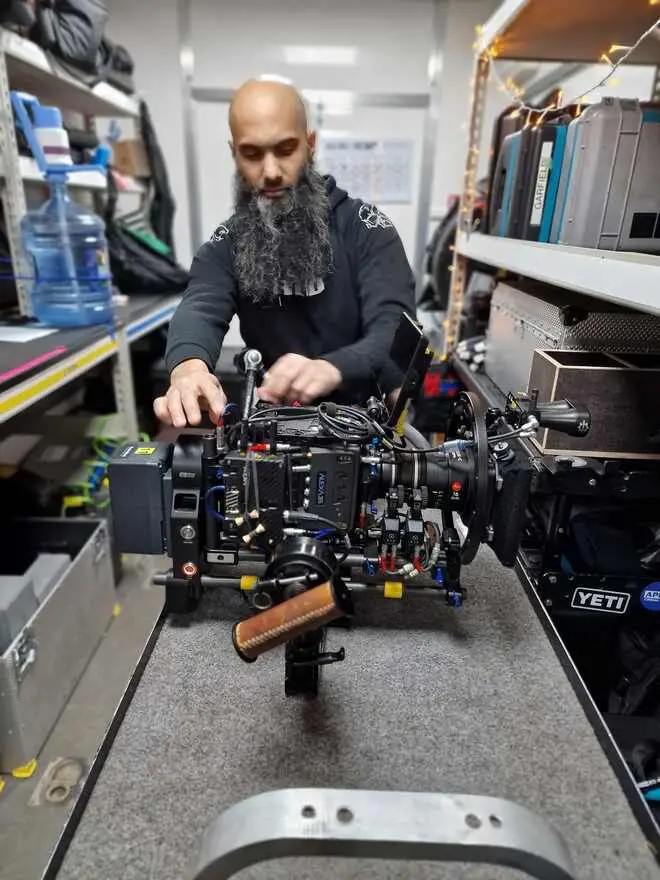
Public liability and kit insurance
The production's insurance usually doesn't cover you, or your kit, when you're self-employed.
Public liability
Covers you if your work hurts someone or damages property. Many productions and locations ask for proof. Bectu Extra includes it; specialist brokers are the other route.
Equipment
Insure owned kit for replacement value: on set, in a vehicle and in transit. Read the small print on unattended vehicles, overnight cover and kit you hire out. Ask if the production's policy covers your kit on their job, and get it in writing.
Income and health
Some freelancers buy income protection for injury or illness. Check what counts as "unable to work" in your job.

Your union
Bectu and the rate cards
We don't print rates: they change every year. Use the current card for your grade.
Rate cards
By department and branch: grades, day length, overtime and other terms. Read yours before you quote or sign.
Membership
Legal support, contract checks, a freelancer tax guide and branch networks for your craft. Subscriptions go by income band, or 1% of earnings with evidence, subject to a minimum. Bectu Extra adds public liability insurance.

Before you say yes
Deal memos and reading a crew contract
A deal memo is a contract, even as a one-page email. Agreed on the phone? Get it in writing before day one.
Read for
- Who you're engaged by: the production company's legal name
- Your grade, the start date and how the end is fixed
- Your rate, the length of the day, and overtime
- Self-employed or PAYE, and on what basis
- Kit or box rental, mileage and per diems
Watch for
- "All-in" or "buy-out" rates that swallow overtime
- A longer day than the rate card for the same money
- Cancellation terms that pay nothing
- Payment terms longer than you can live with
- Clauses you don't understand: ask Bectu before you sign
Say it simply
"Can we put that in the memo?"
The most normal question in the business. Asking won't lose you the job; a vague memo can lose you the money.

The law for workers
No more than 48 hours a week on average, normally over 17 weeks, unless you opt out in writing; you can opt back in. Workers have a right to 11 hours' rest between working days. Under-18s have stricter limits.
Turnaround and driving
Check the turnaround in your deal memo. Too tired to drive home after a long day? Tell your HoD or the production: many will arrange a taxi or a room.
Speak up
Anyone can call stop on something unsafe. Tell your HoD or the 1st AD; if nothing changes, the production's health and safety adviser.
Calculator
Day-rate calculator
Use the rate you've been offered or your grade's Bectu card. Nothing you type leaves this page.
The tax set-aside uses GOV.UK's 2026 to 2027 rates for England, Wales and Northern Ireland, for self-employed profit only. It leaves out student loans, other income and Scottish bands. It's a guide to saving, not your tax bill.
Money
Managing the gaps between jobs
A good year can include months without work. Plan for them while the money's coming in.
- Two accounts, minimumInvoices land in one. Move the tax set-aside to savings the day each payment arrives.
- Pay yourself a wageTransfer the calculator's "steady monthly wage" to your everyday account each month, in work or not.
- Build a bufferAim for a few months of essential costs before you spend on kit or upgrades.
- Use quiet weeksUpdate your CV and reel, do the free courses, call HoDs you've worked with, visit kit houses. Getting work
- If money gets tightThe Film and TV Charity offers grants and financial guidance to people who work behind the scenes. Talk to HMRC early if you can't pay a tax bill: you can ask for a payment plan.

You're not on your own
Mental health and support
Long hours, short contracts and money worries take a toll. Asking for help is part of the job.
24 hours, free
Film and TV Charity Support Line: 0800 054 0000
For anyone who works or has worked behind the scenes in UK film, TV or cinema, including trainees and freelancers. Also grants, financial guidance and a Bullying Advice Service.
Bullying and harassment
CIISA
The Creative Industries Independent Standards Authority: an independent, confidential whistleblowing route for film and TV. It looks for patterns across the industry.
Right now
If you need someone today
Samaritans on 116 123, any time. If a life is at risk, call 999. More helplines on Get help now.
Protect yourself
Job scams
Scammers know new entrants want a break. A real production never asks you to pay to work on it.
Red flags
- Fees for "registration", training, a background check or a place on a crew list
- Being asked to buy kit from a named supplier before you start
- Jobs only on WhatsApp or Telegram, with no company name or address
- A rate far above the rate card for an entry-level job
- Being asked for bank log-ins or passport scans before any offer
- Pressure: "decide in the next hour"
Check it
- Search the company on Companies House
- Look for the production on news sites and the company's own website
- Ask on your Bectu branch or a crew group you trust
- Meet in public, tell someone where you're going
Report it
Report Fraud
In England, Wales and Northern Ireland, Report Fraud replaced Action Fraud as the place to report scams. In Scotland, call Police Scotland on 101.
Checked 13 November 2026
Sources
General information, not legal, tax or financial advice. Rules change: check the source before you rely on it. Spotted something out of date? Tell us.
- HMRC: ESM4120, film and TV roles normally treated as self-employed (updated 7 Oct 2026)
- HMRC: ESM4115, what counts as a specific production, a finite period and a discrete engagement
- GOV.UK: Check employment status for tax (CEST)
- GOV.UK: Understanding off-payroll working (IR35)
- GOV.UK: Register for Self Assessment
- GOV.UK: Income Tax rates and Personal Allowances
- GOV.UK: Self-employed National Insurance rates
- GOV.UK: Payments on account
- GOV.UK: Making Tax Digital for Income Tax, who needs it and when
- GOV.UK: Business records if you're self-employed
- GOV.UK: Expenses if you're self-employed
- GOV.UK: VAT registration
- GOV.UK: Invoices, what they must include
- GOV.UK: Late commercial payments
- UK Parliament: Commercial Payments Bill [HL]
- GOV.UK: Holiday entitlement
- GOV.UK: Workplace pensions
- GOV.UK: Maximum weekly working hours
- Bectu: rate cards
- Bectu: how do I pay tax as a self-employed freelancer?
- The Film and TV Charity: get support
- CIISA: whistleblowing
- Report Fraud (replaced Action Fraud)
Last reviewed 13 November 2026