

Working in the industry · Getting work
Most crew jobs are never advertised. Here's how people get them.
HoDs hire people they know, or people someone they trust recommends. Be easy to recommend: a clear CV, a short reel if your department uses one, and a well-timed email.
Watch first
8From ScreenSkills, BAFTA, the RTS and working crew. They play here.
 1:40How to get your first job in filmScreenSkills · 1:40
 50:55CV masterclass at the RTS Midlands careers fairRoyal Television Society · 50:55
 1:43Set Educated: finding workScreen Careers · 1:43
 2:43Tips for animation and VFX CVs, showreels and portfoliosScreenSkills · 2:43
 1:32How to make the most of your first jobScreenSkills · 1:32
 3:55Join a union or a guild: it introduces you to a networkBAFTA Guru · 3:55
 1:43On trying to break in: be determined, be niceBAFTA Guru · 1:43
 1:02:04How to professionalise yourselfBAFTA Guru · 1:02:04
Free templates
Edit them in Word, Google Docs or Pages, or print them. No sign-up.
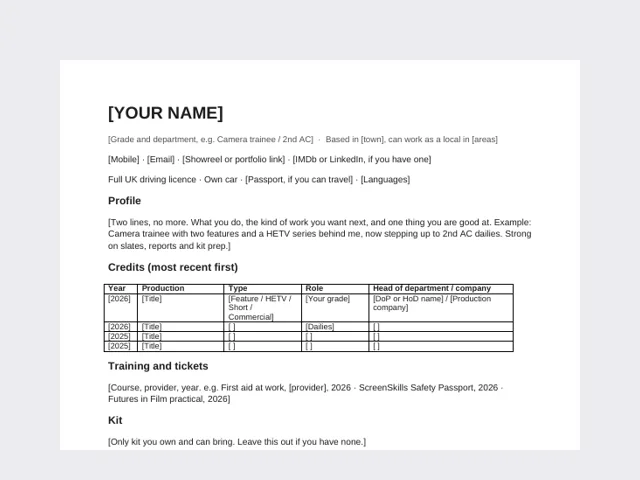 Word · DOCXCrew CV templateOne page, UK crew format: credits table first, most recent at the top.Download Crew CV template (Word · DOCX)
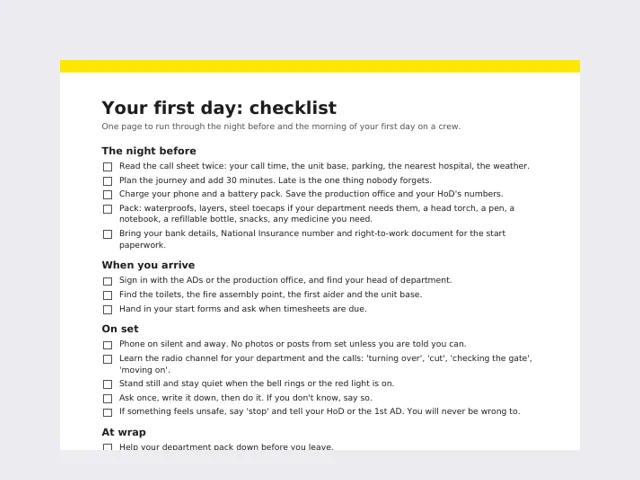 PDF · 1 pageFirst-day checklistThe night before, arriving, on set and at wrap.Download First-day checklist (PDF · 1 page)
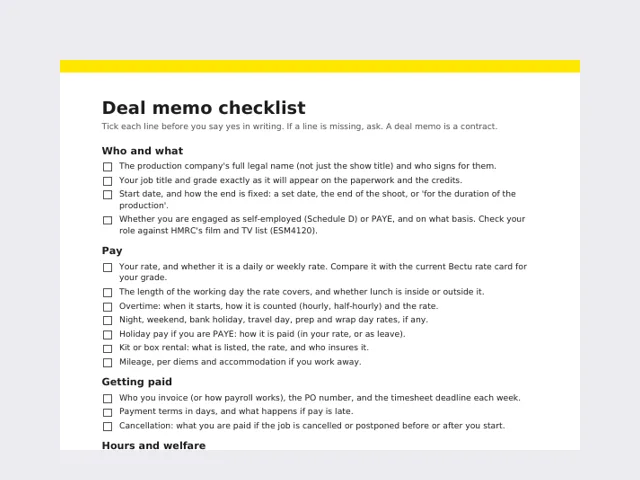 PDF · 1 pageDeal memo checklistFor when the offer comes in.Download Deal memo checklist (PDF · 1 page)
Crew CV
One page. Credits first.
Not an office CV. The reader wants your grade, your credits and who you worked under, in ten seconds.
The order
- Name, grade and department, where you're based and where you can work as a local
- Phone, email, and a link to your reel or portfolio if you have one
- Driving licence and own transport: they matter on location work
- Two lines of profile, no more
- Credits, most recent first: year, production, type, your role, and your HoD or the company
- Training and tickets, kit you own, skills, references
Leave out
- Date of birth, photo, marital status, National Insurance number
- School grades, once you have credits
- Jobs that aren't relevant, unless they show a skill the department uses (driving, customer work, a trade)
- Credits you can't stand behind. People check with the HoD.
No credits yet?
Lead with what you've done
Student and short films, FIF practical days, festival volunteering, kit house days, relevant work outside film. Say exactly what you did. One honest short beats five vague "assisted on" lines.
Preview
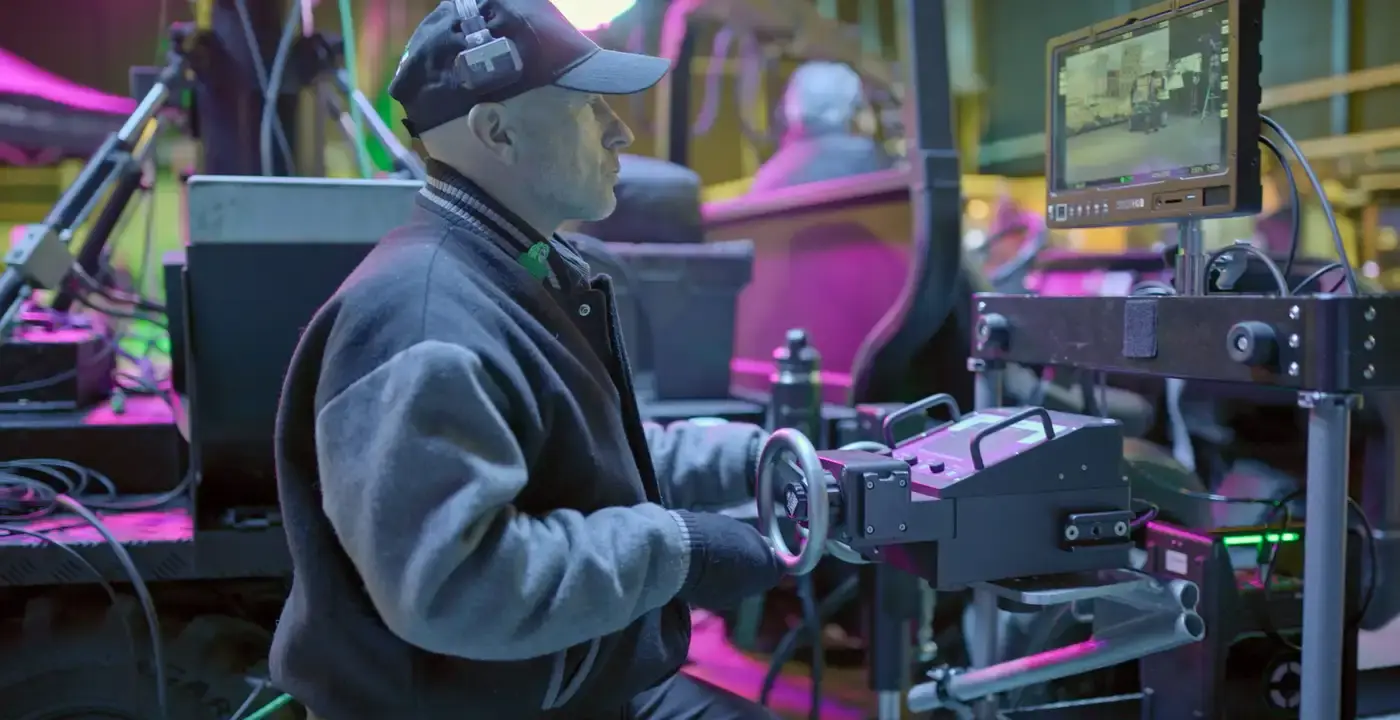
Showreel
Short, your best work first, and your part clear
Editors, operators, DoPs, VFX artists, colourists, sound designers and art department designers get asked for a reel or portfolio. Most other grades are hired on credits and recommendations.
Do
- Open with your strongest 10 seconds
- Keep it short: one to two minutes is plenty early on
- Show your own work, and say what you did on each shot
- Make one link that plays on a phone, with no password, or the password next to it
- Put your name and contact at the end
Don't
- Use music you have no rights to on a public reel
- Include anything under NDA or not yet released without the production's permission
- Pad it out: three good clips beat ten average ones
- Claim a shot you didn't do
No footage yet?
Make it with others
Shoot a scene with other new entrants, in the department you want. Make your own film properly.
Profiles
Be findable, and consistent
Use the same name, grade and photo everywhere. Keep credits identical to your CV. Pay for a subscription only once you know what it gets you.
- ProfileLinkedInWhere production companies, post houses and recruiters look you up. Put your grade and department in the headline.Visit (opens LinkedIn)
- CreditsIMDbProPaid subscription. Your public IMDb credits matter more than the Pro page; check they're right.Visit (opens IMDbPro)
- Jobs and directoryProduction BaseA long-running UK jobs board and crew directory for film, TV and production.Visit (opens Production Base)
- JobsMandyCrew and cast jobs, from shorts to features, with a profile you can point people to.Visit (opens Mandy)
- Jobs and profilesThe Talent ManagerA TV jobs board and talent database. Profiles are free; Pro is an optional upgrade.Visit (opens The Talent Manager)
- Entry levelScreenSkillsJob profiles, a freelance toolkit and trainee schemes. Make a profile and keep your training on it.Visit (opens ScreenSkills)
- Diverse talentCreative AccessJobs, CV and interview support for people under-represented in the creative industries.Visit (opens Creative Access)
- LondonFilm London Equal Access NetworkA free route to work tasters and entry-level roles for Londoners.Visit (opens Film London Equal Access Network)
We have no tie to any of these. Check costs before you sign up.

How it really works
How crew actually get hired
- HoDs pick their teamsThe DoP and focus puller choose the camera team, the gaffer the sparks, the production designer the art department. Production approves the deal. Know the HoD, or the people just above your grade.
- Word of mouth does most of the workWhen a slot opens, the HoD asks their team: "Who do you know?" Every job you do well gets you the next. So does every job where you were late or grumpy, the other way.
- Crew lists and diary servicesProductions and HoDs keep lists of people they've used. Some grades book through crew agents or diary services, usually after a few credits.
- Production offices hire the runnersRunners and PAs are often taken on by the production coordinator or the 2nd AD. A well-timed email to the office works.
- Schemes, kit houses and showsTrainee schemes, rental house days and industry events put you in front of people who hire. See Get support and Events and expos.
- TimingCrews are booked in prep, a few weeks before the shoot. Find out what's in prep near you from regional screen agencies, trade press and studio news.
First contact
Emails that get read
Short, specific, polite. One person per email, by name. A clear subject line. CV as a PDF with your name in the file name.
To a head of department
Subject: Camera trainee, available from [date], based in [town]

Dear [Name],

I'm a camera trainee based in [town], and I'd love to be considered for your team on [production] or a future job.

I've worked as [role] on [production or course], where I [one specific thing you did]. I can work as a local in [area], have a full licence and my own car.

My CV is attached. I'm available from [date] and happy to cover dailies.

Thank you for your time.

[Your name]
[Phone]
To a production office
Subject: Runner, available [dates], local to [area]

Hello [Name, or the production coordinator],

I understand [production] is in prep in [area]. I'm a runner local to [area], with [one line of relevant experience], a full licence and my own car.

My CV is attached. I'm available [dates], including early calls and weekends.

Many thanks,
[Your name]
[Phone]
After someone recommends you
Subject: [Name of the person] suggested I get in touch

Dear [Name],

[Name of the person], who I worked with on [production], suggested I contact you. I'm a [grade] based in [town], looking to work in your department.

My CV is attached. If you ever need someone for dailies or a short job, I'd be glad to help.

Kind regards,
[Your name]
[Phone]
Following up
Polite, then patient
Once, after about two weeks
Reply to your own email: "Just checking this reached you. I'm still available from [date]." Then leave it.
Check in when something changes
A new credit, a new ticket, a move: a reason to write again, every few months at most.
Keep a simple list
Who you wrote to, when, and what they said. When someone says "try me again in March", put it in your calendar.
Thank people
After any job, thank your HoD and whoever recommended you.

You got the job
Your first day
Read the call sheet, arrive early, ask once and write it down.
Your first week on set: walkies, calls, and days one to five.
The night before
- Call time, unit base, parking and the nearest hospital, from the call sheet
- Route planned, with 30 minutes spare
- Phone charged, numbers saved
- Bank details, NI number and right-to-work document for the start forms
On the day
- Sign in, find your HoD, toilets and the fire assembly point
- Phone away; no photos or posts from set
- Stay still and quiet when the bell rings
- If something looks unsafe, say so. You will never be wrong to.
Before you start
Check the paperwork
Know if you're on PAYE or self-employed, and what you agreed. Deal memos explained
Last reviewed 13 November 2026