
Day One
- Lesson2 of 6
- Time40 min
Who's who, and how a shooting day runs
Outcome
Name the people who run the floor and describe the order of a set-up, from blocking to 'moving on'.
Mapped to 2 ScreenSkills checklist lines
- ScreenSkills floor runner / set PA skills checklist · Core responsibilities: "Warn departments in advance about location moves, set moves and wrap"
- ScreenSkills floor runner / set PA skills checklist · Skills: "Work well with your own and other departments"
ScreenSkills checklists are guides, not accreditation. This course is not endorsed by ScreenSkills.
Watch
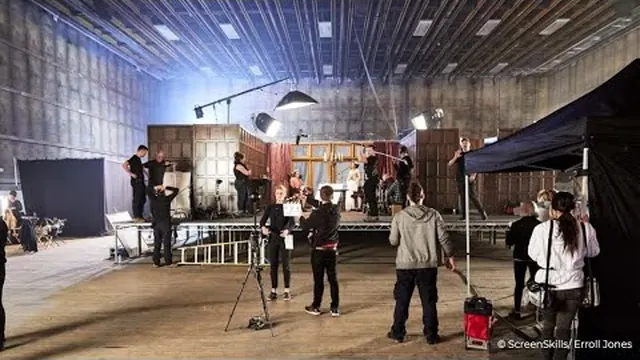
3 films · about 27 minutes
Your browser blocked the player's tracking script, so watch time can't be credited here. Use the demo skip below.
More like this: Scheduling and the AD department path · Your first day on set path
Films are made and owned by the channels named, and play from YouTube. Inclusion here is not an endorsement either way.
Who runs what
- The director leads the story and the performances. The 1st AD runs the floor and the schedule: they call the rehearsals, the turnover and the wrap.
- The 2nd AD looks after the call sheet, the cast's day and the next day's plan, usually from unit base. The 3rd AD works on the floor with the floor runners, moving cast and background.
- Each department has a head of department (HoD): the director of photography (DoP) for camera and lighting, the production designer for art, the costume designer, the make-up and hair designer, the production sound mixer, and so on. Your HoD, or the person they put you with, gives you your work.
The order of a set-up
- Block: the director and the cast rehearse the scene so everyone can see the moves. HoDs watch. This is often a closed or 'private' rehearsal first, then a marking rehearsal for crew.
- Mark: the camera assistants lay actors' marks; sound and camera note positions.
- Light: the cast go to costume and make-up ('into the works'). Stand-ins, known as second team, hold the marks while camera and lighting set up. The actors in the scene are first team.
- Rehearse: first team come back for a final rehearsal with camera.
- Shoot: turnover, slate, action, cut. Then more takes, then the next angle on the same scene (coverage), and 'moving on' to the next set-up.
Base and set
- Unit base is where the trucks, trailers, costume, make-up and catering park. The set is where you film. They can be a long walk apart; allow for it.
- The working day ends with 'that's a wrap'. Departments then de-rig and pack. Your day ends when your HoD says so.
Check
3 questions drawn from 8 · pass mark 80% · safety-critical questions must be right · 3 attempts in 24 hours · new questions each time
Watch the films to open the check.
Do
Put the day in order · 10 minutes
Number these moments in the order they happen on a normal shooting day, then say who calls each one.
How it's marked
- Order is right: unit call, blocking, second team in, turnover, moving on, wrap
- Names the 1st AD for turnover, moving on and wrap
Met or Not yet, with a comment from a trained reviewer. Until accounts open, open the model answer after you submit and mark your own work against it.
Model answer (open after you submit)
Unit call, blocking rehearsal, second team in for lighting, turnover, moving on, wrap. The 1st AD calls turnover, moving on and wrap; the production confirms the wrap time.
Reflect
Record
This is everything kept about this lesson. In the pilot it's held by Futures in Film CIC in your account; Screen Sisters CIC sees named records only if you agree. Your data
Moving on doesn't complete a lesson. A lesson is complete when the films are watched, the check is passed and the task is marked Met.