
Camera Foundation
- Lesson7 of 8
- Time45 min
Lenses, T-stops and depth of field
Outcome
Explain focal length, T-stops and the four things that change depth of field, and predict which set-up is harder to keep sharp.
Mapped to 2 ScreenSkills checklist lines
- ScreenSkills second assistant camera / clapper loader skills checklist · Core responsibilities: "Select and hand over requested lenses to the first AC"
- ScreenSkills second assistant camera / clapper loader skills checklist · Core responsibilities: "Mark up and call out focus marks when needed"
ScreenSkills checklists are guides, not accreditation. This course is not endorsed by ScreenSkills.
Watch
2 films · about 20 minutes
Your browser blocked the player's tracking script, so watch time can't be credited here. Use the demo skip below.
More like this: Focus pulling (1st AC) path
Films are made and owned by the channels named, and play from YouTube. Inclusion here is not an endorsement either way.
Focal length
- Focal length (in millimetres) sets the field of view. Short (wide) lenses see more; long lenses see less and appear to compress distance.
- Cinema primes are usually named by focal length: 'the 25', 'the 50', 'the 75'.
T-stops
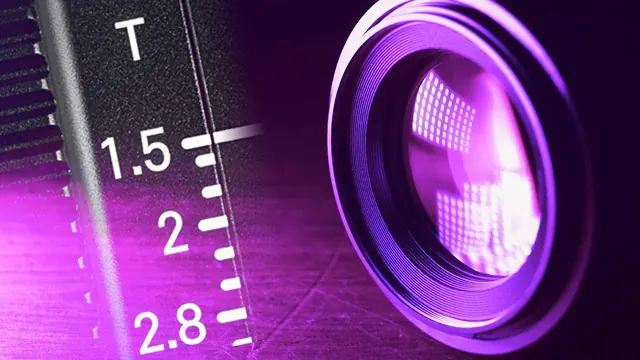
- An f-stop is a calculation from the lens's size. A T-stop is measured: how much light actually gets through. Cinema lenses are marked in T-stops so that every lens in a set gives the same exposure at the same stop.
- A lower number (T2) lets in more light than a higher one (T5.6). Each full stop halves or doubles the light.
Depth of field
- Depth of field is how much of the scene, from near to far, looks acceptably sharp.
- Four things change it: aperture (a wider stop, lower number, gives less depth), focal length (longer gives less), distance to the subject (closer gives less), and sensor or format size (larger formats give less at the same framing).
- Less depth of field looks beautiful and is hard to keep sharp. That's why the focus puller is so valued, and why marks matter.
Check
3 questions drawn from 8 · pass mark 80% · safety-critical questions must be right · 3 attempts in 24 hours · new questions each time
Watch the films to open the check.
Do
Which is harder to keep sharp? · 10 minutes
Rank these three set-ups from hardest to easiest for the focus puller, and give one reason for each.
How it's marked
- A hardest: long lens, wide stop, moving subject
- C next: a rack between two marks at a moderate stop
- B easiest: wide lens, smaller stop, static subject
- Reasons use stop, focal length, distance or movement
Met or Not yet, with a comment from a trained reviewer. Until accounts open, open the model answer after you submit and mark your own work against it.
Model answer (open after you submit)
Hardest A (long lens, wide stop, moving and getting closer), then C (a planned rack between two marked distances, moderate depth), easiest B (wide lens, T5.6, still subject).
Reflect
Record
This is everything kept about this lesson. In the pilot it's held by Futures in Film CIC in your account; Screen Sisters CIC sees named records only if you agree. Your data
Moving on doesn't complete a lesson. A lesson is complete when the films are watched, the check is passed and the task is marked Met.