
Play · Your first day
Make the small calls that get you asked back.
A fictional first day as a runner. Choose what you would do, see what happens, and read the section that explains why.
Watch: your first job, from people who hire runners
 How to get your first job in filmScreenSkills · original on YouTube
 What a Floor Runner ( SET PA ) does on Film and TV Sets - AD DEPARTMENTEG TIPS · original on YouTube
 How do you get work as a runner, a researcher and an assistant producer (AP) in TV documentaries?ScreenSkills · original on YouTube
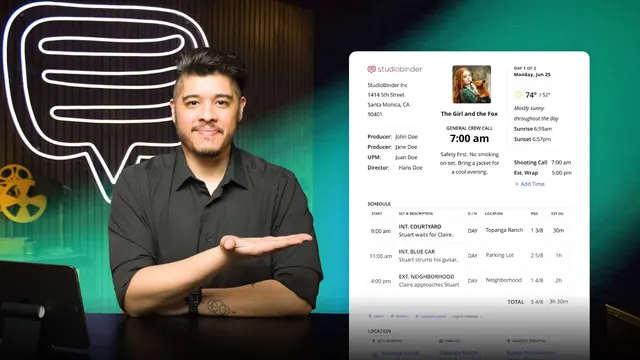 What is a Call Sheet — What Goes On It and WhyStudioBinder Academy · original on YouTube
You have been offered a first day as a runner on a fictional shoot. Ten small decisions, each with a consequence. Nothing is a dead end, and you can step back and try another choice.
The call sheet lands
Home, the evening before. It is 18:10. The call sheet for tomorrow has arrived. Your call is 07:00 and the unit is out of town.
- Read it twice and work out my real leaving time, allowing at least an extra half hour. Good. Everything on the sheet is a commitment made on your behalf, and call time means ready to work, not arriving. Next: Nobody has said what you are paid.
- Skim it. I will see what is what when I get there. Risky. You miss that the unit base and the location are different places, and you have not worked out a leaving time. Call time is when you start work, not when you reach the gate. Next: Nobody has said what you are paid.
Read: What do I do the night before?
Nobody has said what you are paid
Home, the evening before. You realise nobody has confirmed your rate, your hours or how overtime works.
- Send a short message asking for the rate, the standard day and overtime in writing. An email is enough. Good. Get the deal in writing before the day, however small the job. A deal memo is the document that covers your pay, hours and overtime. Next: Unit base or location?.
- Leave it. It would feel awkward to ask, and it will probably be fine. That is how people end up chasing money later. Get the deal in writing before the day, however small the job. Next: Unit base or location?.
Read: What should I settle in writing before day one?
Unit base or location?
On the road, 05:50. The sheet names a unit base and a location. They are in different places. You are meant to go to one of them first.
- Check the call sheet and the movement order, and head for the place they say. Good. The movement order covers how to reach the location and the unit base, and where to park. Next: You have arrived.
- Head straight for the location. That is where the filming is. That is the commonest first-day mistake. The two places are often a shuttle apart. Next: You are in the wrong place.
Read: The call sheet, line by line
You are in the wrong place
Wrong place, 06:40. You have arrived at the wrong place and it is getting close to your call. You need to get to the right one.
- Tell your department straight away, then get to the right place by the quickest route on the movement order. Recoverable. People are rarely sent home for not knowing something technical. If you get something wrong, say so straight away. Next: You have arrived.
- Say nothing and hope to slip in unnoticed. That makes it worse. If you get something wrong, say so straight away. Next: You have arrived.
Read: Etiquette: tell someone straight away
You have arrived
At the right place, ahead of call. You are early. There are trucks, people moving fast and breakfast on. Nobody has come over to meet you.
- Find my head of department and tell them I have arrived. Good. Be early, not on time, and find your head of department. Next: The blocking rehearsal.
- Wait by the catering truck until someone finds me. Not ideal. Find your head of department and tell them you have arrived. Don't wait to be found. Next: The blocking rehearsal.
Read: What gets people asked back
The blocking rehearsal
On set, 08:20. The director, cast, DoP and 1st AD are walking through the first scene. You have no job to do for ten minutes.
- Stand well back and watch. Good. The rehearsal decides the next three hours, so watching it is how you learn what is coming. Next: Your phone buzzes.
- Move closer to hear better. Don't walk through a shot. Stand well back and watch, because this decides the next three hours. Next: Your phone buzzes.
Read: The shape of the day
Your phone buzzes
On set, 09:10. Your phone buzzes against your leg. It was on silent, and a take is about to start.
- Turn it off properly, not to silent. Good. A phone on silent still interferes with radio mics. Next: A cable across the walkway.
- Leave it. It is on silent, so it is fine. It is not fine. A phone on silent still interferes with radio mics, and the sound mixer can stop a take for a noise nobody else can hear. Next: A cable across the walkway.
Read: Why does it go so quiet?
A cable across the walkway
On set, 11:30. Mid-take, you see a cable across the walkway. Someone carrying kit is about to walk towards it.
- Say 'cut' loudly, at once. Good. 'Cut' belongs to the director, or anybody, for safety. If you see something dangerous, say so, loudly, at once. Nobody will be angry with you. Next: You knock something over.
- Wait for the end of the take, then mention it quietly. That is the serious one. If you see something dangerous, say so, loudly, at once. Next: You knock something over.
Read: The calls, and who says each one
You knock something over
On set, 13:40. Carrying a flag stand, you clip a light stand. Nothing is damaged beyond a scuffed leg, but you are not sure.
- Tell the department straight away that I knocked it, and that I am not sure it is fine. Good. If you break something or get it wrong, say so straight away. Next: 'That's the Abby Singer'.
- Put it back and say nothing. If you break something or get it wrong, say so straight away. Next: 'That's the Abby Singer'.
Read: What gets people asked back
'That's the Abby Singer'
On set, 17:20. You hear the 1st AD: 'That's the Abby Singer.'
- Think about how my department gets packed, and be ready for the wrap. Good. The Abby Singer is the second-to-last shot, and the Martini is the last. When you hear the first, think about how your department gets packed. That ends the day.
- It is not my shot, so I carry on as I was. A missed cue. When you hear the Abby Singer, think about how your department gets packed. That ends the day.
Read: The shape of the day
How the day can end
- Asked back. You were early, in the right place, quiet when it mattered and loud when it was safe to be. You did the small things, and the small things are what get people asked back. Role page: Camera trainee: the role page. Watch: What A Gaffer Does On Set: Crew Breakdown (In Depth Cine).
- A bumpy day you can build on. A few things went wrong, but you owned them and carried on. That is a good sign. Read the sections below for the ones that slipped, and you will not make them twice. Role page: Runner: the role page. Watch: What a Floor Runner (Set PA) does on Film and TV Sets (EG TIPS).
- A rough day. Several habits that matter on a set went the wrong way, including a safety one. It happens, and none of it is technical. Go through the notes below and try the day again with different choices. Role page: Production assistant: the role page. Watch: What Makes a Good 1st AD? (Filmmaking Stuff).
This is a practice scenario, not a rule book. The advice comes from our guides to your first day and how a set works; your own production and head of department have the last word.
Last reviewed 9 November 2026