Working in the industry · Access
Ask for what you need. It's part of the job.
For Deaf, disabled and neurodivergent crew, and the HoDs who book them. Access riders, Access to Work, and how to ask without losing the booking.
Watch first
7Access to Work, access coordinators and working on set. They play here.
 5:32Your guide to Access to WorkDiversity and Ability · 5:32
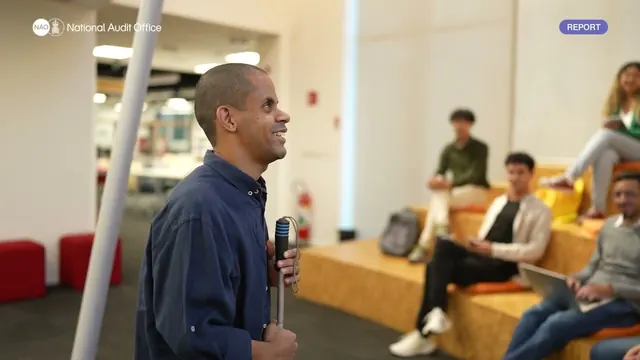 2:01The Access to Work schemeNational Audit Office · 2:01
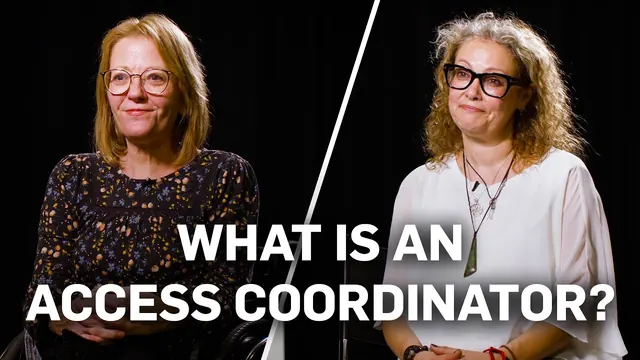 5:33What is an access coordinator?Screen Australia · 5:33
 13:32Accessibility in film and TVOKRE · 13:32
 1:09Neurodiversity and life on set: A Kind of SparkBYUtv · 1:09
 13:53TripleC honoured for championing disabled talentBAFTA · 13:53
 48:38Is TV somewhere you can work if you have a disability?Royal Television Society · 48:38
Free templates
Edit in Word, Google Docs or Pages, or print and fill in. No sign-up.
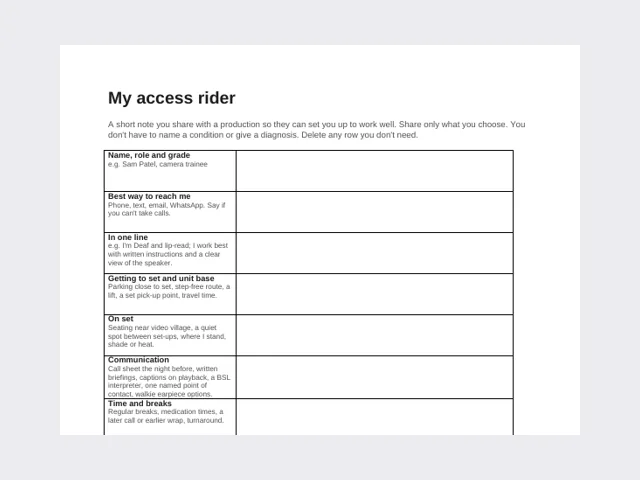 Word · DOCXAccess rider templateFill in what you need on set. Share only what you choose.Download Access rider template (Word · DOCX)
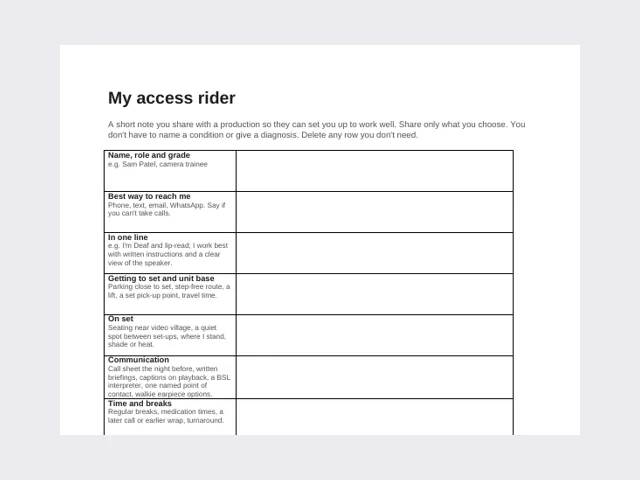 PDFAccess rider to printThe same rider, to print and fill in by hand.Download Access rider to print (PDF)
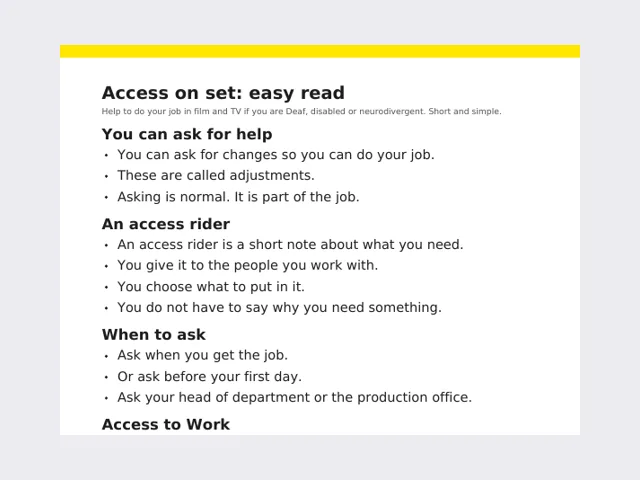 PDF · easy readAccess on set: easy readThis guide in short, simple sentences and large print.Download Access on set: easy read (PDF · easy read)
Access rider
One page that does the explaining
An access rider is a short note of what helps you work. Send it once per job, so you're not explaining yourself to every new face.
What goes in
- Getting to set: parking, step-free route, pick-up point
- On set: a chair at video village, a quiet spot at unit base
- Communication: call sheet the night before, text not just walkie, captions, a BSL interpreter
- Breaks, medication times, turnaround
- Kit you bring or need
- Getting out in an emergency
What stays out
- Your diagnosis. You don't have to name a condition.
- Your medical history
- Anything you'd rather not share
Say what helps, not why.
When to send it
After the offer, with the deal memo
Send it to your HoD and the production office. If there's an access coordinator, send it to them first. Update it for each job.
Access to Work
A government grant for the extra costs of working
It pays for support you need because of a disability or a physical or mental health condition. You don't pay it back, and it doesn't affect your benefits.
- Check you qualify16 or over, in paid work or starting within 12 weeks, living and working in England, Scotland or Wales. Self-employed? Your turnover must be at least £6,500 a year.
- Apply online or by phoneApply on GOV.UK, or call 0800 121 7479 (Relay UK: 18001 then 0800 121 7479). There's a BSL video relay service too. Freelancers need their UTR.
- Apply earlyWaits are long. In October 2026 Graeae reported around 37 weeks for employed people and around 67 weeks for the self-employed. Apply before the job you need it for.
- Keep your rider and award togetherSend both to the production office so they know who pays for what.
It can pay for
- A support worker: BSL interpreter, job coach, note-taker
- Taxis to work if you can't use public transport
- Specialist equipment and software
- Mental health support at work
It won't pay for
Reasonable adjustments the employer must make by law. Those are the production's job.
Northern Ireland
There's a separate scheme. Access to Work on nidirect

The law
Reasonable adjustments
Under the Equality Act 2010, employers must make reasonable adjustments for disabled workers. It can cover freelancers too, if you're booked to do the work yourself. Ask Acas or Bectu about your own case.
Unit base and set
- Parking near set
- A step-free route and an accessible loo
- A chair at video village
Communication
- Call sheet and movement order the night before
- Calls by text as well as walkie
- Captions on playback
- Face the person when you give a note
Time
- Fixed breaks
- A later call or earlier wrap
- Time off for appointments
Short bookings
Day-rate jobs move fast
There's little time to set things up. Send your rider early, and ask the production office who sorts access on this job.
A growing role
Access coordinators
They make sure Deaf, disabled and neurodivergent cast and crew get what they need, from prep to wrap. ScreenSkills lists the role as one of those growing in UK high-end TV.
Is there one on this job?
Ask the production office. If there is, talk to them before your first day.
No coordinator?
Access usually sits with the production manager or line producer. Send your rider to them and your HoD.
Want to do the job?
TripleC and ScreenSkills have run access coordinator training. TripleC
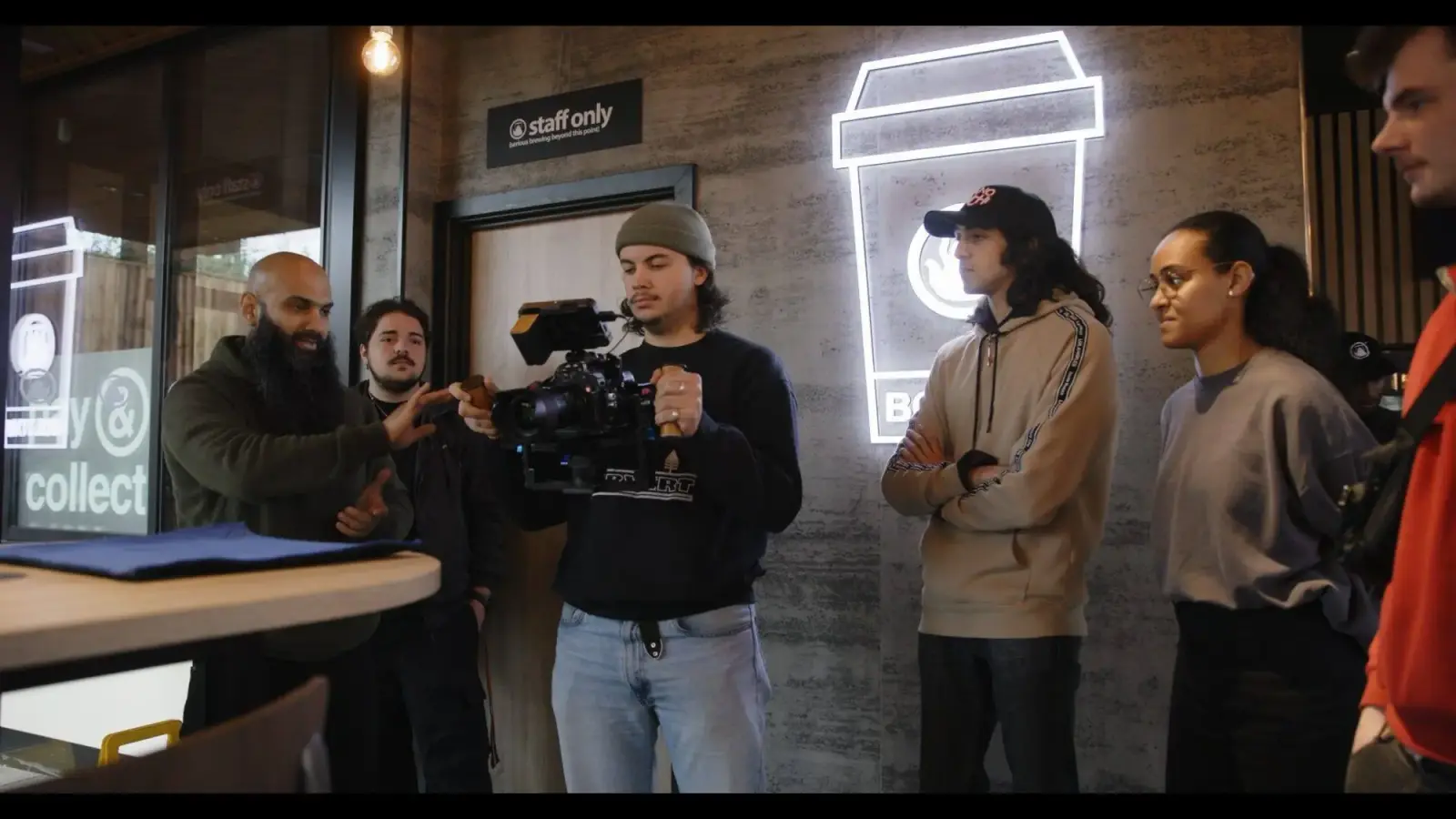
Neurodivergent crew
Small changes that help on a busy floor
Sets are loud, fast and change all day. These are small asks most HoDs will say yes to.
- The call sheet the night before, and changes in writing
- One person to go to, and a clear handover each morning
- Lists or photos for the kit you prep
- Tell your HoD how you take a note best: shown, written or said
- Know where the quiet spot is at unit base
- Ear defenders between takes, but never when you need to hear safety calls
- A heads-up before a big change of set-up or location
How to ask
Asking without losing the booking
It's unlawful to turn someone down because they're disabled. Most HoDs just want to know what makes the day work.
- Get the offer firstYou don't have to mention a disability when you're pencilled or interviewed.
- Lead with the job"To do this well, I need…" puts the focus on the work.
- Keep it specific"Could the call sheet come by email the night before?" is easy to say yes to.
- Put it in writingReply to the deal memo email with your rider attached.
- If it goes wrongTalk to your HoD, then the production manager. Then get advice: the Film and TV Charity's Bullying Advice Service covers discrimination, including adjustments not made. Bectu and Acas can help too.
Say it simply: "I'm Deaf, so I'm on text, not the walkie. Can someone ping me the calls?"
For HoDs and production
Plan access in prep
- Ask everyone the same question at booking: "Anything we should plan for?"
- Budget for access in prep, and allow for Access to Work waits
- Name one contact for access on the job
- Keep riders private. Share only with people who need them.
- Put personal emergency evacuation plans (PEEPs) in the risk assessment
- Plan a quiet space and an accessible loo at unit base
You're not on your own
Help and funding
24 hours, free
Film and TV Charity: 0800 054 0000
Work and Wellbeing advisers can help with Access to Work and PIP forms. There's a "Working Well With Me" template too.
Network and funding
TripleC
Deaf, disabled and neurodivergent people in media. Its Access Funding Scheme for high-end TV crew paid £100 to £1,000 for access costs; the 2026 round closed on 16 January 2026. Watch for the next.
Easy read
This guide in plain words
Short sentences, large print.
Checked 13 Nov 2026
Sources
General information, not legal advice. Rules change: check the source. Spotted something out of date? Tell us.
- GOV.UK: Access to Work
- GOV.UK: Access to Work eligibility (self-employed turnover £6,500)
- GOV.UK: Apply for Access to Work
- nidirect: Access to Work (Northern Ireland)
- Acas: reasonable adjustments
- Film and TV Charity: disability support
- TripleC: Access Funding Scheme
- ScreenSkills: Access Funding Scheme for HETV Deaf, disabled and neurodivergent crew 2026
- Graeae: Access to Work 2026 (waiting times)
- ScreenSkills: HETV research, 19 Mar 2026 (new roles growing, including access coordinators)
Last reviewed 13 November 2026